It’s no secret the news media has been turning more and more to social media to gather basic information, graphics, reach out to sources and keep updated on various stories it tries to report on. Social Media is the channel for information, it’s the quickest way to reach out to the most amount of people at one time, discover what’s trending and pull commentary for a story. It acts as salon for information and if a journalist keeps his or her ears open to what’s happening he or she’s bound to walk away with something valuable. But how does a journalist determine what conversations are “private” and what conversations are not in the microcosms that are Twitter, Facebook and Reddit threads.
Journalists really can’t.
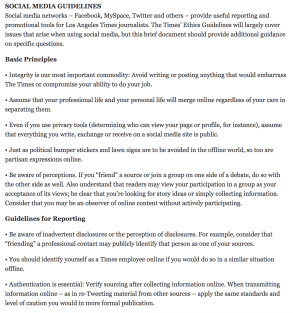
In the LA Time’s Ethics Guidelines, the news publication addresses the basic principles a journalists working for them should follow when managing their social media presence. The list is reminds journalists to engage with social media no differently than they would engage in person, with one exception. The list does not include a rule about taking information from someone’s profile or feed and using it in a story.
In the real world, as opposed to the digital world social media inhabits, when journalists want a quote they must first get their quote from their source directly, verify what is and is not approved to be used in their story, and sources are almost always aware of their presence in a story.
The real world process protects journalists from libel charges and, most importantly, from burning bridges with sources. In the digital world, as far as journalists are concerned, no posted material is off the record. And the lines have gotten even blurrier when it comes to videos and images.
“People are increasingly aware of their intellectual property and will say ‘it’s my picture, and I want something for it’.” – David Banks
David Banks, a media law consultant, people are becoming increasingly aware of what property is there’s and for journalists just trying to use an image taken from Facebook can cause a huge commotion.
“People are increasingly aware of their intellectual property and will say ‘it’s my picture, and I want something for it’,” said Banks.
Additionally, there are not only ethical issues, but moral issues that arise when choosing to use a photo from Facebook, Twitter or any other social site.
A year ago, after the mass shooting in Orlando at Pulse Night Club, pictures of the victims of the attack were aired on television, published on multiple new sites and made into videos. Many of the pictures were taken from sites like Facebook and, in the context of the event, using them revealed a the victims’ personal life to the world without their approval — that they were likely gay. That news was discretionary, but because many of the victims died as a result of their injuries, no one could dispute the media’s uses of the images, alerting unaware of families to information they would not have otherwise known.
Social Media has, no doubt, become essential to the preserving of news information media. It, in many ways, acts as the news’ saving grace. It’s brought journalists closer to their audience than ever before, but in now journalists much be more careful than ever before. Journalists are as employees of the People. The last thing they want to do is create distrust between them and the People because of theft, copyright infringement and unnecessary violation of personal privacy.
 glennepps.com