Customers are finding themselves at the mercy of cable company’s high prices.
- Cable options are limited for people who rent and who live in cable deserts because of the growth of monopolies in the cable market.
- Residents who rent in Ithaca, NY are limited to three options when they purchase cable, internet or landline phone service: DirectTV, Dish TV and Spectrum Cable.
- Charter is stalling for a new contract with the state of NY after being told to leave the state for failing to fulfill its contractual agreements with the state within the specified timeframe.
Dani Perkins waited all day for the cable man to show up to her job. She did her daily tasks, sent her emails, made her phone calls, had her meetings and when the day came to an end the cable man never arrived. When she called the Spectrum cable company she was told that they would not be sending over a technician because they were terminating a portion of their agreement. Fortunately for her, and unlike most people, she didn’t have to take off a day of work. She was waiting for the cable to be installed at her job. Unfortunately, Spectrum didn’t provide an explanation why they were terminating their contract at the time, and they didn’t have to. Spectrum had made a unilateral decision about the terms of their contract with Ithaca College and the college couldn’t do anything about it. It had no bargaining chip because Spectrum was its only option.
The short answer to why Spectrum stopped servicing individual rooms at Ithaca College is that it was too expensive for the cable company to continue providing service any longer.
The slightly longer answer is that the cost and the gain were “not worth it,” said Beth O’Neil, associate director of residential life and judicial affairs at the college. Students weren’t settling for the prices that came with signing the cable contract. They were high and, with access to streaming increasing, they weren’t competitive enough. But that doesn’t mean that cable is dying. On the contrary, cable is managing to sustain itself, especially in towns with no other option.
On college campuses, in public housing and in towns like Ithaca where renting is the norm, “cable” is a far more popular option than dish and its gaudy and damaging satellite.
In Ithaca, three options are available to residents who want to purchase cable, internet or landline phone service: DirectTV, Dish TV and Spectrum Cable. Spectrum is the only ground cable provider which means that if a landlord doesn’t want a satellite on their roof, it’s essentially the renter’s only option.
Bob Adele, a property manager for Travis Hyde Properties said that his residents are free to purchase any cable they want–as long as it doesn’t include a dish. “It puts a hole in the roof,” he said. “So they [the residents] mostly just stream.”
David Kramer, owner of 16 houses in Ithaca, which he rents to graduate students said that his tenants aren’t alone– he also feels the burden. He doesn’t have cable but he does have internet and Spectrum is the only sole internet provider.
“You have to Spectrum if you’re going to have Internet,” he said. “Once, years ago, I said ‘look I’m unhappy with these prices I want you to disconnect me’ and they lowered the cost for me for a year. They’re such bastards, I really wish there was some other option.”
When asked why he doesn’t allow his tenants or himself to access one of the dish options, he said that not only are they unsightly, but it’s unhealthy for a building to have holes. Holes rot and can ruin the integrity of a building slowly, over time, said Kramer, who is well-known for renovating historic houses in the community.
See the breakdown of the price difference for a common housing unit in Ithaca, NY:
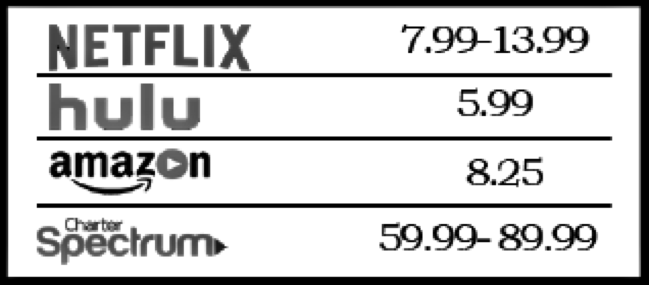
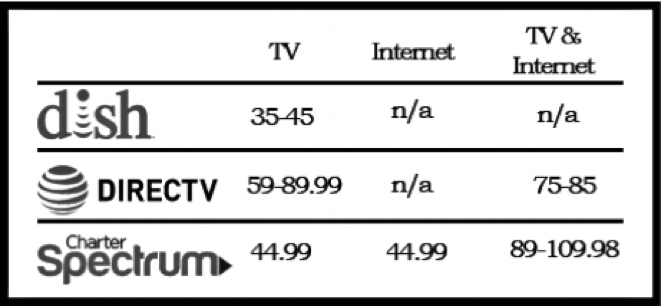
In a price comparison, Spectrum cable doesn’t hold up well. Compared to the most popular streaming services, Spectrum is three times more expensive than even the most expensive streaming platform. Compared to television and internet providers, it is the second most expensive TV provider in Ithaca and the most expensive provider of TV and internet.
And among cable internet providers, Spectrum’s speed isn’t as competitive as other options. Verizon Fios, which uses fiber optic cable is the best option for techies, cord-cutters and home offices, according to HighSpeedExperts. In another comparison, Xfinity bests Charter with “top tier speeds.” Unfortunately, neither of those providers are available to Ithaca residents.
When Charter Communications merged with Time Warner Cable in 2015, the companies became the second largest television and internet provider in the U.S. spanning 29 states, over 167 million households and it gave Charter control of all of TWC’s cable lines. In New York alone, Spectrum is the largest internet provider; it provides for 57 percent of the state’s internet, and is the largest cable provider outside of New York City (42 percent). It provides cable to 93 percent of Tompkins County residents.
In order for another cable provider like Verizon Fios or Xfinity from Comcast to compete with Spectrum in the region, the company would either need to lay its own lines throughout the city or rent/buy them from Charter, which is an expensive deal to make. Charter is the sole provider of cable internet in the Tompkins County, according to highspeedinternet.com. Comcast, which uses the same network infrastructure as Charter, would have to either rent lines or install them itself to gain access to Ithaca residents..
On the other hand, Verizon Fios would be forced to either buy lines from Charter or install its own, an endeavor that would cost them upwards of $25,000 per home, according to analysts from the Columbia Telecommunications Corporation. Fiber cable are designed for customers who use their internet frequently, but “because fiber cable is so expensive to install, Verizon has been slow to roll out extensive coverage,” states HighSpeedExperts which has left rural, sparsely populated areas under-coveraged. Their slow expansion has even resulted in a lawsuit from New York State over broken promises.
“The cable industry is a patchwork of micro-monopolies. Or more accurately, natural monopolies: situations of little or no competition that doesn’t break enough laws to get regulated,” reports Mat Honan of Gizmodo. “A natural monopoly occurs when it’s so expensive to enter a market that it doesn’t make sense for a competitors to come in. With cable TV, there’s a massive fixed cost to enter a new market—putting in new cable lines. So, basically, whoever showed up first—or the company that bought them—has the legacy right of being the local cable company.”
There are 448 cable providers nationwide, reports BroadbandNow, but they largely operate in pockets. Smaller providers, like Haefle Connect and Ontario and Trumansburg Phone Companies, struggle to expand because of infrastructure costs and natural monopolies. When government regulation of cable-internet providers’ exclusive rights arrived too late in 1992, after decades of manipulation, it was too late. Larger companies had already divided the nation and taken their corners.
After failing to meet its deadline on expanding its network to rural communities in July, New York administrators voted to kick out the Spectrum. The state ordered the television, cable and internet giant to find another company to replace it in 60 days and be removed from the state within six months. New York’s Department of Public Service (DPS) granted Charter its fourth extension Nov. 26.
Stop the Cap!, a consumer group advocating for better business standards from Charter, are requesting that company remain in New York and
- Further extend Spectrum service to additional customers in rural New York scheduled to receive satellite internet service;
- Increase entry-level broadband speed to at least 200 Mbps immediately and further extend availability of Everyday Low Price Internet service ($14.99/mo);
- Settle the ongoing labor dispute with striking Spectrum workers in downstate New York
Whether Spectrum stays or leaves, customers can expect a change, but what the change will be is anyone’s guess. The DPS’s extension to Charter ends on Dec. 14. Charter has until then to file an appeal with the Commission.
 glennepps.com